ANE TODAY VOL III n9 (2015)

[vc_row fullwidth=”true” css=”.vc_custom_1486761987223{padding-top: 0px !important;padding-right: 0px !important;padding-bottom: 0px !important;padding-left: 0px !important;}”][vc_column][vc_single_image image=”33901″ img_size=”full”][/vc_column][/vc_row][vc_row fullwidth=”true” css=”.vc_custom_1487275830783{padding-top: 10px !important;padding-right: 0px !important;padding-bottom: 0px !important;padding-left: 0px !important;}”][vc_column width=”1/12″ css=”.vc_custom_1493002455400{margin-right: 10px !important;}” offset=”vc_hidden-md vc_hidden-sm vc_hidden-xs”][vc_column_text]

泭釦晨插賊楚

[/vc_column_text][mk_image src=”http://www.asortest.org/wp-content/uploads/2017/01/social-fb-icon4.jpg” image_width=”42″ image_height=”42″ hover=”false” custom_url=”https://www.facebook.com/ASOResearch/” margin_bottom=”0″][mk_image src=”http://www.asortest.org/wp-content/uploads/2017/01/social-tw-icon4.jpg” image_width=”42″ image_height=”42″ hover=”false” custom_url=”https://twitter.com/ASOResearch?ref_src=twsrc%5Egoogle%7Ctwcamp%5Eserp%7Ctwgr%5Eauthor” margin_bottom=”0″][mk_image src=”http://www.asortest.org/wp-content/uploads/2017/01/social-in-icon4.jpg” image_width=”42″ image_height=”42″ hover=”false” custom_url=”https://www.linkedin.com/company/american-schools-of-oriental-research” margin_bottom=”0″][mk_image src=”http://www.asortest.org/wp-content/uploads/2017/01/social-ml-icon_7.jpg” image_width=”42″ image_height=”42″ hover=”false” custom_url=”mailto:asor@bu.edu” margin_bottom=”0″][mk_image src=”http://www.asortest.org/wp-content/uploads/2017/01/blog-icon3.jpg” image_width=”42″ image_height=”42″ hover=”false” custom_url=”http://asorblog.org/” margin_bottom=”0″][/vc_column][vc_column border_color=”rgba(255,255,255,0.01)” width=”1/6″ css=”.vc_custom_1493004112151{margin-right: 20px !important;border-left-width: 2px !important;padding-right: 20px !important;padding-left: 20px !important;border-left-color: #99422f !important;}”][mk_divider divider_color=”rgba(255,255,255,0.01)” thickness=”1″ margin_top=”3″ margin_bottom=”3″][vc_widget_sidebar sidebar_id=”sidebar-16″ el_class=”.widget { overflow: hidden; margin-bottom: 0; }”][/vc_column][vc_column border_color=”rgba(170,170,170,0.01)” width=”8/12″ css=”.vc_custom_1487276122024{margin-right: 10px !important;margin-bottom: 30px !important;border-right-width: 2px !important;border-bottom-width: 2px !important;padding-top: 30px !important;padding-right: 30px !important;padding-left: 20px !important;background-color: #ffffff !important;border-right-color: rgba(227,228,228,0.75) !important;border-bottom-color: rgba(227,228,228,0.75) !important;}”][vc_row_inner][vc_column_inner width=”1/3″ css=”.vc_custom_1515087305797{padding-right: 20px !important;}”][mk_image src=”http://www.asor.org/wp-content/uploads/2017/12/foa-reduced-100.png” image_width=”190″ image_height=”100″ crop=”false” hover=”false”][/vc_column_inner][vc_column_inner width=”2/3″][vc_column_text responsive_align=”left”]

September 2015

Vol. 3, No. 9
[/vc_column_text][/vc_column_inner][/vc_row_inner][mk_divider thickness=”1″ margin_top=”0″][vc_row_inner][vc_column_inner][vc_column_text]Welcome to The Ancient Near East Today Vol. 3, No. 9! In this issue we cover over 350,000 years, from the advent of fire to the destruction of sites in Syria and Iraq.

We begin with Reinhard Pirngruber���s look at policemen in Mesopotamia. From there we turn to James Strange on Jewish life at Shikhin in the Southern Galilee, then Ron Shimelmitz discusses of new evidence for the first use of fire. Columba Stewart describes the work of the Hill Museum & Manuscript Library, photographing Christian manuscripts in Syria and Iraq. We are pleased to present an image gallery of some of those manuscripts. Finally, we include a special set of links reviewing the ongoing destruction and looting of antiquities in Syria.

As always, please forward articles from The Ancient Near East Today to family and friends, post links to Facebook, and be in touch with the editor. Remember, being a Friend of ASOR is free![/vc_column_text][mk_divider thickness=”1″ margin_top=”0″][vc_column_text]

Special Feature: Syria Destruction Update

News accounts and propaganda videos continue to report ISIL���s destruction of archaeological sites in Syria, and the ongoing devastation caused by the civil war. The Ancient Near East Today is sad to present a series of the most recent links discussing these situations.

READ MORE
[/vc_column_text][mk_divider thickness=”1″ margin_top=”10″][vc_column_text]

Shikhin Between Jews and Romans

By: James Riley Strange

Most archaeological sites in the ancient world are important for one reason or another. But every once in awhile, archaeologists uncover one that that helps them solve long-standing problems, or that opens up a new tin of questions that must be answered.

READ MORE
[/vc_column_text][mk_divider thickness=”1″ margin_top=”10″][vc_column_text]

Hill Museum & Manuscript Library: Manuscripts Image Gallery

Through the courtesy of Dr. Columba Stewart OSB and the Hill Museum & Manuscript Library, we are pleased to present a sample of monastic manuscripts scanned in Syrian collections. These pages provide a hint of the treasures that have been preserved and those that have been lost.

READ MORE
[/vc_column_text][mk_divider thickness=”1″ margin_top=”10″][vc_column_text]

Hill Museum & Manuscript Library: Working to Preserve the Manuscript Heritage of Syria and Iraq

By: Columba Stewart, OSB

The Hill Museum & Manuscript Library at Saint John���s University in Collegeville, Minnesota (HMML) began in 1965 as a project to microfilm monastic libraries in Cold War Europe. The Benedictine monks of Saint John���s Abbey were concerned that their European heritage could be destroyed in a nuclear war, and were determined to take precautionary measures.

READ MORE
[/vc_column_text][mk_divider thickness=”1″ margin_top=”10″][vc_column_text]

Fire: a Burning Issue in Human Evolution

By: Ron Shimelmitz

ire is reflected in almost every aspect of our mundane existence; its use and control constitutes an essential part of material life. From cooking our meals to the various materials we use, the products of pyrotechnology, fire is also an intimate component in human social life.

READ MORE
[/vc_column_text][mk_divider thickness=”1″ margin_top=”10″][vc_column_text]The Ancient Near East Today��features contributions from diverse academics, a forum featuring debates of current developments from the field, and links to news and resources. The ANE Today��covers the entire Near East, and each issue presents discussions ranging from the state of biblical archaeology to archaeology after the Arab Spring.

[/vc_column_text][mk_divider thickness=”1″ margin_top=”10″][/vc_column_inner][/vc_row_inner][/vc_column][/vc_row]

ANE TODAY VOL III n10 (2015)

[vc_row fullwidth=”true” css=”.vc_custom_1486761987223{padding-top: 0px !important;padding-right: 0px !important;padding-bottom: 0px !important;padding-left: 0px !important;}”][vc_column][vc_single_image image=”33901″ img_size=”full”][/vc_column][/vc_row][vc_row fullwidth=”true” css=”.vc_custom_1487275830783{padding-top: 10px !important;padding-right: 0px !important;padding-bottom: 0px !important;padding-left: 0px !important;}”][vc_column width=”1/12″ css=”.vc_custom_1493002455400{margin-right: 10px !important;}” offset=”vc_hidden-md vc_hidden-sm vc_hidden-xs”][vc_column_text]

泭釦晨插賊楚

[/vc_column_text][mk_image src=”http://www.asortest.org/wp-content/uploads/2017/01/social-fb-icon4.jpg” image_width=”42″ image_height=”42″ hover=”false” custom_url=”https://www.facebook.com/ASOResearch/” margin_bottom=”0″][mk_image src=”http://www.asortest.org/wp-content/uploads/2017/01/social-tw-icon4.jpg” image_width=”42″ image_height=”42″ hover=”false” custom_url=”https://twitter.com/ASOResearch?ref_src=twsrc%5Egoogle%7Ctwcamp%5Eserp%7Ctwgr%5Eauthor” margin_bottom=”0″][mk_image src=”http://www.asortest.org/wp-content/uploads/2017/01/social-in-icon4.jpg” image_width=”42″ image_height=”42″ hover=”false” custom_url=”https://www.linkedin.com/company/american-schools-of-oriental-research” margin_bottom=”0″][mk_image src=”http://www.asortest.org/wp-content/uploads/2017/01/social-ml-icon_7.jpg” image_width=”42″ image_height=”42″ hover=”false” custom_url=”mailto:asor@bu.edu” margin_bottom=”0″][mk_image src=”http://www.asortest.org/wp-content/uploads/2017/01/blog-icon3.jpg” image_width=”42″ image_height=”42″ hover=”false” custom_url=”http://asorblog.org/” margin_bottom=”0″][/vc_column][vc_column border_color=”rgba(255,255,255,0.01)” width=”1/6″ css=”.vc_custom_1493004112151{margin-right: 20px !important;border-left-width: 2px !important;padding-right: 20px !important;padding-left: 20px !important;border-left-color: #99422f !important;}”][mk_divider divider_color=”rgba(255,255,255,0.01)” thickness=”1″ margin_top=”3″ margin_bottom=”3″][vc_widget_sidebar sidebar_id=”sidebar-16″ el_class=”.widget { overflow: hidden; margin-bottom: 0; }”][/vc_column][vc_column border_color=”rgba(170,170,170,0.01)” width=”8/12″ css=”.vc_custom_1487276122024{margin-right: 10px !important;margin-bottom: 30px !important;border-right-width: 2px !important;border-bottom-width: 2px !important;padding-top: 30px !important;padding-right: 30px !important;padding-left: 20px !important;background-color: #ffffff !important;border-right-color: rgba(227,228,228,0.75) !important;border-bottom-color: rgba(227,228,228,0.75) !important;}”][vc_row_inner][vc_column_inner width=”1/3″ css=”.vc_custom_1515087305797{padding-right: 20px !important;}”][mk_image src=”http://www.asor.org/wp-content/uploads/2017/12/foa-reduced-100.png” image_width=”190″ image_height=”100″ crop=”false” hover=”false”][/vc_column_inner][vc_column_inner width=”2/3″][vc_column_text responsive_align=”left”]

October 2015

Vol. 3, No. 10
[/vc_column_text][/vc_column_inner][/vc_row_inner][mk_divider thickness=”1″ margin_top=”0″][vc_row_inner][vc_column_inner][vc_column_text]Welcome to The Ancient Near East Today Vol. 3, No. 10! In this issue we go from ancient music to ancient artifacts, with stops in the first century and an attic in Jerusalem.

We begin with Howard Feldman���s reminiscence of the science behind the controversial Jehoash tablet. Next is Scott Gleaves’ provocative discussion about whether Jesus spoke Greek rather than Aramaic. Rachel Hallote takes us into uncharted territory: the Albright Institute���s attic. Uri Gabbay reviews the surprisingly ample evidence for music in Mesopotamia. With summer field seasons over, we���re proud to take a look at new reports from recipients of 17勛圖scholarships.

As always, please forward articles from The Ancient Near East Today to family and friends, post links to Facebook, and be in touch with the editor. Remember, being a Friend of ASOR is free![/vc_column_text][mk_divider thickness=”1″ margin_top=”10″][vc_column_text]

Music in Ancient Mesopotamia

By: Uri Gabbay

We have a wealth of sources from ancient Mesopotamia: archeological, iconographical, and, most significantly, textual. Hundreds of thousands of cuneiform tablets in collections around the world shed light on the everyday life, economy, law, literature, and religion of ancient Mesopotamia.

READ MORE
[/vc_column_text][mk_divider thickness=”1″ margin_top=”10″][vc_column_text]

Excavating the Albright Institute���s Attic

By: Rachel Hallote

Many 17勛圖members who excavate in Israel use the Albright Institute���s attic for storage���it���s a convenient place to keep ceramics and other excavation materials, as well as summer dig clothes. It���s just like any other attic. But it is also a kind of archaeological site in itself.

READ MORE
[/vc_column_text][mk_divider thickness=”1″ margin_top=”10″][vc_column_text]

Did Jesus Speak Greek?

By: G. Scott Gleaves

Did Jesus and his disciples speak and teach in Greek? What languages were spoken in first century Palestine? If so, does the New Testament preserve their actual communications?

READ MORE
[/vc_column_text][mk_divider thickness=”1″ margin_top=”10″][vc_column_text]

The Jehoash Affair: A Personal Recollection

By: Howard R. Feldman

In recent years few artifacts have captured as much attention as the Jehoash inscription. The dark stone tablet, only 10 inches by 12 inches, bears a 15 line Hebrew inscription describing renovations made to the Jerusalem temple by the Judean king Jehoash, son of Ahaziya, around the year 800 BCE.

READ MORE
[/vc_column_text][mk_divider thickness=”1″ margin_top=”10″][vc_column_text]The Ancient Near East Today��features contributions from diverse academics, a forum featuring debates of current developments from the field, and links to news and resources. The ANE Today��covers the entire Near East, and each issue presents discussions ranging from the state of biblical archaeology to archaeology after the Arab Spring.

[/vc_column_text][mk_divider thickness=”1″ margin_top=”10″][/vc_column_inner][/vc_row_inner][/vc_column][/vc_row]

ANE TODAY VOL III n11 (2015)

[vc_row fullwidth=”true” css=”.vc_custom_1486761987223{padding-top: 0px !important;padding-right: 0px !important;padding-bottom: 0px !important;padding-left: 0px !important;}”][vc_column][vc_single_image image=”33901″ img_size=”full”][/vc_column][/vc_row][vc_row fullwidth=”true” css=”.vc_custom_1487275830783{padding-top: 10px !important;padding-right: 0px !important;padding-bottom: 0px !important;padding-left: 0px !important;}”][vc_column width=”1/12″ css=”.vc_custom_1493002455400{margin-right: 10px !important;}” offset=”vc_hidden-md vc_hidden-sm vc_hidden-xs”][vc_column_text]

泭釦晨插賊楚

[/vc_column_text][mk_image src=”http://www.asortest.org/wp-content/uploads/2017/01/social-fb-icon4.jpg” image_width=”42″ image_height=”42″ hover=”false” custom_url=”https://www.facebook.com/ASOResearch/” margin_bottom=”0″][mk_image src=”http://www.asortest.org/wp-content/uploads/2017/01/social-tw-icon4.jpg” image_width=”42″ image_height=”42″ hover=”false” custom_url=”https://twitter.com/ASOResearch?ref_src=twsrc%5Egoogle%7Ctwcamp%5Eserp%7Ctwgr%5Eauthor” margin_bottom=”0″][mk_image src=”http://www.asortest.org/wp-content/uploads/2017/01/social-in-icon4.jpg” image_width=”42″ image_height=”42″ hover=”false” custom_url=”https://www.linkedin.com/company/american-schools-of-oriental-research” margin_bottom=”0″][mk_image src=”http://www.asortest.org/wp-content/uploads/2017/01/social-ml-icon_7.jpg” image_width=”42″ image_height=”42″ hover=”false” custom_url=”mailto:asor@bu.edu” margin_bottom=”0″][mk_image src=”http://www.asortest.org/wp-content/uploads/2017/01/blog-icon3.jpg” image_width=”42″ image_height=”42″ hover=”false” custom_url=”http://asorblog.org/” margin_bottom=”0″][/vc_column][vc_column border_color=”rgba(255,255,255,0.01)” width=”1/6″ css=”.vc_custom_1493004112151{margin-right: 20px !important;border-left-width: 2px !important;padding-right: 20px !important;padding-left: 20px !important;border-left-color: #99422f !important;}”][mk_divider divider_color=”rgba(255,255,255,0.01)” thickness=”1″ margin_top=”3″ margin_bottom=”3″][vc_widget_sidebar sidebar_id=”sidebar-16″ el_class=”.widget { overflow: hidden; margin-bottom: 0; }”][/vc_column][vc_column border_color=”rgba(170,170,170,0.01)” width=”8/12″ css=”.vc_custom_1487276122024{margin-right: 10px !important;margin-bottom: 30px !important;border-right-width: 2px !important;border-bottom-width: 2px !important;padding-top: 30px !important;padding-right: 30px !important;padding-left: 20px !important;background-color: #ffffff !important;border-right-color: rgba(227,228,228,0.75) !important;border-bottom-color: rgba(227,228,228,0.75) !important;}”][vc_row_inner][vc_column_inner width=”1/3″ css=”.vc_custom_1515087305797{padding-right: 20px !important;}”][mk_image src=”http://www.asor.org/wp-content/uploads/2017/12/foa-reduced-100.png” image_width=”190″ image_height=”100″ crop=”false” hover=”false”][/vc_column_inner][vc_column_inner width=”2/3″][vc_column_text responsive_align=”left”]

November 2015

Vol. 3, No. 11
[/vc_column_text][/vc_column_inner][/vc_row_inner][vc_row_inner][vc_column_inner][mk_divider thickness=”1″ margin_top=”10″][vc_column_text]Welcome to��The Ancient Near East Today��Vol. III, No. 11!��In this issue we go from Israel to Rhodes, from Turkey to Denmark, with a stop in Syria.

We begin with Richard Freund���s discussion of the ancient and modern Jewish presence on the island of Rhodes. Mara Horowitz then brings us up to date on the renewed excavations at the enormous site of Alalakh in Turkey, then��Flemming Kaul and Jeanette Varberg discuss tiny finds ��� glass beads ��� that open entirely new perspectives on trade, between Denmark and Egypt.

As part of our continuing coverage of the cultural heritage crisis in Syria and Iraq, we present a page of important new reports and news links. We also are proud to link to ASOR���s journals, and, as always, to reports from students supported by 17勛圖scholarships.

As always, please forward articles from��The Ancient Near East Today��to family and friends, post links to Facebook, and be in touch with��the editor. Remember, being a��Friend of ASOR��is free![/vc_column_text][mk_divider thickness=”1″ margin_top=”10″][/vc_column_inner][/vc_row_inner][vc_row_inner][vc_column_inner][vc_column_text]

Between Ancient Rhodes and Israel: Comparing Literary and Material Cultures

By: Richard Freund

The ancient Mediterranean world was formed of countless interconnections. I have been working at Bethsaida, a city by the north shore of the Sea of Galilee for the past 25 years. Part of our work has been to map the roads system connecting Bethsaida to the coast and to the Mediterranean beyond.

READ MORE
[/vc_column_text][mk_divider thickness=”1″ margin_top=”10″][/vc_column_inner][/vc_row_inner][vc_row_inner][vc_column_inner][vc_column_text]

Introducing the Lanier Theological Library

By: Mark Lanier

What do Madame Gertrude Bell, Cappadocian Fathers, U.S. Supreme Court Justice Antonin Scalia, Nuzi tablets, Dead Sea Scroll fragments, Moshe Goshen-Gottstein, and William Hallo have in common? They have all found a home, of sorts, at the Lanier Theological Library (���LTL���) in Houston, Texas.

READ MORE
[/vc_column_text][mk_divider thickness=”1″ margin_top=”10″][/vc_column_inner][/vc_row_inner][vc_row_inner][vc_column_inner][vc_column_text]

A Call for the Preservation of Heritage Landscapes in the United Arab Emirates

By: Ronald Hawker

I always say that the best semester of my academic career was my sabbatical, when I spent six months combing through the dusty abandoned farms and hamlets of Ras al-Khaimah on a research project funded by Zayed University and an Emirates Foundation grant in the winter of 2011.

READ MORE
[/vc_column_text][mk_divider thickness=”1″ margin_top=”10″][/vc_column_inner][/vc_row_inner][vc_row_inner][vc_column_inner][vc_column_text]

Narrative Literature of Hurrian Origin: Moving Treasures from the Ancient Near East

By: Mauro Giorgieri

The Hurrians were one of the most important civilizations of the Ancient Near East but we have far less linguistic, historical and archaeological information about them than the Sumerians, Babylonians, Assyrians, or Hittites. Hurrian epic poems are also a fascinating but lesser known aspect of Ancient Near Eastern literary traditions. Read more[/vc_column_text][mk_divider thickness=”1″ margin_top=”10″][vc_column_text]

Who���s the Fairest of them all? Feminine Beauty in the Hebrew Bible and Iron Age Ivory Sculpture

By: Amy Rebecca Gansell

From fairy tales to fashion magazines, notions of feminine beauty pervade the world we live in. But what does the Hebrew Bible have to say about this topic? And how might archaeological artifacts help us to see and understand ancient beauty?

賊楚插嗨泭紼倏賊楚
[/vc_column_text][mk_divider thickness=”1″ margin_top=”0″][/vc_column_inner][/vc_row_inner][vc_row_inner][vc_column_inner][vc_column_text]The Ancient Near East Today��features contributions from diverse academics, a forum featuring debates of current developments from the field, and links to news and resources. The ANE Today��covers the entire Near East, and each issue presents discussions ranging from the state of biblical archaeology to archaeology after the Arab Spring.

[/vc_column_text][mk_divider thickness=”1″ margin_top=”10″][/vc_column_inner][/vc_row_inner][/vc_column][/vc_row]

ANE TODAY VOL III n12 (2015)

[vc_row fullwidth=”true” css=”.vc_custom_1486761987223{padding-top: 0px !important;padding-right: 0px !important;padding-bottom: 0px !important;padding-left: 0px !important;}”][vc_column][vc_single_image image=”33901″ img_size=”full”][/vc_column][/vc_row][vc_row fullwidth=”true” css=”.vc_custom_1487275830783{padding-top: 10px !important;padding-right: 0px !important;padding-bottom: 0px !important;padding-left: 0px !important;}”][vc_column width=”1/12″ css=”.vc_custom_1493002455400{margin-right: 10px !important;}” offset=”vc_hidden-md vc_hidden-sm vc_hidden-xs”][vc_column_text]

泭釦晨插賊楚

[/vc_column_text][mk_image src=”http://www.asortest.org/wp-content/uploads/2017/01/social-fb-icon4.jpg” image_width=”42″ image_height=”42″ hover=”false” custom_url=”https://www.facebook.com/ASOResearch/” margin_bottom=”0″][mk_image src=”http://www.asortest.org/wp-content/uploads/2017/01/social-tw-icon4.jpg” image_width=”42″ image_height=”42″ hover=”false” custom_url=”https://twitter.com/ASOResearch?ref_src=twsrc%5Egoogle%7Ctwcamp%5Eserp%7Ctwgr%5Eauthor” margin_bottom=”0″][mk_image src=”http://www.asortest.org/wp-content/uploads/2017/01/social-in-icon4.jpg” image_width=”42″ image_height=”42″ hover=”false” custom_url=”https://www.linkedin.com/company/american-schools-of-oriental-research” margin_bottom=”0″][mk_image src=”http://www.asortest.org/wp-content/uploads/2017/01/social-ml-icon_7.jpg” image_width=”42″ image_height=”42″ hover=”false” custom_url=”mailto:asor@bu.edu” margin_bottom=”0″][mk_image src=”http://www.asortest.org/wp-content/uploads/2017/01/blog-icon3.jpg” image_width=”42″ image_height=”42″ hover=”false” custom_url=”http://asorblog.org/” margin_bottom=”0″][/vc_column][vc_column border_color=”rgba(255,255,255,0.01)” width=”1/6″ css=”.vc_custom_1522444053218{margin-right: 20px !important;margin-bottom: 0px !important;border-bottom-width: 0px !important;border-left-width: 2px !important;padding-right: 20px !important;padding-bottom: 0px !important;padding-left: 20px !important;border-left-color: #99422f !important;border-bottom-color: #99422f !important;}”][mk_divider divider_color=”rgba(255,255,255,0.01)” thickness=”1″ margin_top=”3″ margin_bottom=”3″][vc_widget_sidebar sidebar_id=”sidebar-16″ el_class=”.widget { overflow: hidden; margin-bottom: 0; }”][/vc_column][vc_column border_color=”rgba(170,170,170,0.01)” width=”8/12″ css=”.vc_custom_1487276122024{margin-right: 10px !important;margin-bottom: 30px !important;border-right-width: 2px !important;border-bottom-width: 2px !important;padding-top: 30px !important;padding-right: 30px !important;padding-left: 20px !important;background-color: #ffffff !important;border-right-color: rgba(227,228,228,0.75) !important;border-bottom-color: rgba(227,228,228,0.75) !important;}”][vc_row_inner][vc_column_inner width=”1/3″ css=”.vc_custom_1515087305797{padding-right: 20px !important;}”][mk_image src=”http://www.asor.org/wp-content/uploads/2017/12/foa-reduced-100.png” image_width=”190″ image_height=”100″ crop=”false” hover=”false”][/vc_column_inner][vc_column_inner width=”2/3″][vc_column_text responsive_align=”left”]

December 2015

Vol. 3, No. 12
[/vc_column_text][/vc_column_inner][/vc_row_inner][mk_divider thickness=”1″ margin_top=”0″][vc_column_text]Welcome to The Ancient Near East Today Vol. III, No. 12! In this issue we go from Israel to Rhodes, from Turkey to Denmark, with a stop in Syria.

We begin with Richard Freund���s discussion of the ancient and modern Jewish presence on the island of Rhodes. Mara Horowitz then brings us up to date on the renewed excavations at the enormous site of Alalakh in Turkey, then��Flemming Kaul and Jeanette Varberg discuss tiny finds ��� glass beads ��� that open entirely new perspectives on trade, between Denmark and Egypt.

As part of our continuing coverage of the cultural heritage crisis in Syria and Iraq, we present a page of important new reports and news links. We also are proud to link to ASOR���s journals, and, as always, to reports from students supported by 17勛圖scholarships.

As always, please forward articles from The Ancient Near East Today to family and friends, post links to Facebook, and be in touch with the editor. Remember, being a Friend of ASOR is free![/vc_column_text][mk_divider thickness=”1″ margin_top=”0″][vc_row_inner][vc_column_inner][vc_column_text]

(Very) Long Distant Trade ��� Egyptian, Mesopotamia and Denmark in the Late Bronze Age

By: Flemming Kaul and Jeanette Varberg

Archaeologists frequently talk about ���long distance trade.��� But sometimes those distances are very long.Early glass was a rare and expensive luxury that was traded along the coasts of the Mediterranean between Egypt, the Near East and Mycenaean Greece in ships like the Uluburun shipwreck, excavated off the coast of Turkey, dating to the late 13th Century BCE.

READ MORE
[/vc_column_text][/vc_column_inner][/vc_row_inner][mk_divider thickness=”1″ margin_top=”10″][vc_column_text]

New Excavations in the Plain of Antioch

By: Mara T. Horowitz

The vibrant Bronze Age city of Alalakh on the Plain of Antioch may not have been among the largest cities of the ancient Near East, but its strategic importance and unique character made it a star. Ongoing excavations and research directed by K. Asl覺han Yener and sponsored by Ko癟 University are revealing the extraordinary history of ancient Alalakh (Tell Atchana)

READ MORE
[/vc_column_text][mk_divider thickness=”1″ margin_top=”10″][vc_row_inner][vc_column_inner][vc_column_text]The Ancient Near East Today��features contributions from diverse academics, a forum featuring debates of current developments from the field, and links to news and resources. The ANE Today��covers the entire Near East, and each issue presents discussions ranging from the state of biblical archaeology to archaeology after the Arab Spring.

[/vc_column_text][/vc_column_inner][/vc_row_inner][/vc_column][/vc_row]

ANE TODAY VOL IV n10 (2016)

[vc_row fullwidth=”true” css=”.vc_custom_1486761987223{padding-top: 0px !important;padding-right: 0px !important;padding-bottom: 0px !important;padding-left: 0px !important;}”][vc_column][vc_single_image image=”33901″ img_size=”full”][/vc_column][/vc_row][vc_row fullwidth=”true” css=”.vc_custom_1487275830783{padding-top: 10px !important;padding-right: 0px !important;padding-bottom: 0px !important;padding-left: 0px !important;}”][vc_column width=”1/12″ css=”.vc_custom_1493002455400{margin-right: 10px !important;}” offset=”vc_hidden-md vc_hidden-sm vc_hidden-xs”][vc_column_text]

泭釦晨插賊楚

[/vc_column_text][mk_image src=”http://www.asortest.org/wp-content/uploads/2017/01/social-fb-icon4.jpg” image_width=”42″ image_height=”42″ hover=”false” custom_url=”https://www.facebook.com/ASOResearch/” margin_bottom=”0″][mk_image src=”http://www.asortest.org/wp-content/uploads/2017/01/social-tw-icon4.jpg” image_width=”42″ image_height=”42″ hover=”false” custom_url=”https://twitter.com/ASOResearch?ref_src=twsrc%5Egoogle%7Ctwcamp%5Eserp%7Ctwgr%5Eauthor” margin_bottom=”0″][mk_image src=”http://www.asortest.org/wp-content/uploads/2017/01/social-in-icon4.jpg” image_width=”42″ image_height=”42″ hover=”false” custom_url=”https://www.linkedin.com/company/american-schools-of-oriental-research” margin_bottom=”0″][mk_image src=”http://www.asortest.org/wp-content/uploads/2017/01/social-ml-icon_7.jpg” image_width=”42″ image_height=”42″ hover=”false” custom_url=”mailto:asor@bu.edu” margin_bottom=”0″][mk_image src=”http://www.asortest.org/wp-content/uploads/2017/01/blog-icon3.jpg” image_width=”42″ image_height=”42″ hover=”false” custom_url=”http://asorblog.org/” margin_bottom=”0″][/vc_column][vc_column border_color=”rgba(255,255,255,0.01)” width=”1/6″ css=”.vc_custom_1493004112151{margin-right: 20px !important;border-left-width: 2px !important;padding-right: 20px !important;padding-left: 20px !important;border-left-color: #99422f !important;}”][mk_divider divider_color=”rgba(255,255,255,0.01)” thickness=”1″ margin_top=”3″ margin_bottom=”3″][vc_widget_sidebar sidebar_id=”sidebar-16″ el_class=”.widget { overflow: hidden; margin-bottom: 0; }”][/vc_column][vc_column border_color=”rgba(170,170,170,0.01)” width=”8/12″ css=”.vc_custom_1487276122024{margin-right: 10px !important;margin-bottom: 30px !important;border-right-width: 2px !important;border-bottom-width: 2px !important;padding-top: 30px !important;padding-right: 30px !important;padding-left: 20px !important;background-color: #ffffff !important;border-right-color: rgba(227,228,228,0.75) !important;border-bottom-color: rgba(227,228,228,0.75) !important;}”][vc_row_inner][vc_column_inner width=”1/3″ css=”.vc_custom_1515087305797{padding-right: 20px !important;}”][mk_image src=”http://www.asor.org/wp-content/uploads/2017/12/foa-reduced-100.png” image_width=”190″ image_height=”100″ crop=”false” hover=”false”][/vc_column_inner][vc_column_inner width=”2/3″][vc_column_text responsive_align=”left”]

October 2016

Vol. 4, No. 10
[/vc_column_text][/vc_column_inner][/vc_row_inner][mk_divider thickness=”1″ margin_top=”0″][vc_row_inner][vc_column_inner][vc_column_text]

Letters from Baghdad: Excavating the Story of the Extraordinary Gertrude Bell

By Elizabeth Rodriguez Chandler

It is curious how in less than a century, the story of Gertrude Bell has been diminished in history, when the imprint of ���Miss Bell,��� as she is still called by Iraqis today, on the modern history of Iraq is undeniable. And yet, her relevance to modern Iraq might be as high as it has ever been.

READ MORE
[/vc_column_text][mk_divider thickness=”1″ margin_top=”10″][/vc_column_inner][/vc_row_inner][vc_row_inner][vc_column_inner][vc_column_text]

Multi-Dimensional Yahwism: The Case of the Persian Period Judaean Community in Elephantine

By Gard Graner繪d

When reading Jewish literature from the Second Temple period (the Persian, Hellenistic and Roman periods) in light of Nehemiah 8, one gets the impression that the Torah (the Books of Moses)���in one form or another���was the common spiritual denominator accepted by all branches of developing Judaism.

READ MORE
[/vc_column_text][mk_divider thickness=”1″ margin_top=”10″][/vc_column_inner][/vc_row_inner][vc_row_inner][vc_column_inner][vc_column_text]

Ancient Pilgrimage in the Modern World

By Rangar Cline

A 2012 WIN-Gallup study found a notable decline in religiosity around the globe, and that 33% of the world���s population describe themselves as non-religious or atheist. A 2012 Pew survey identified similar trends in the U.S. But one aspect of religious behavior remains more popular than ever.

READ MORE
[/vc_column_text][mk_divider thickness=”1″ margin_top=”10″][/vc_column_inner][/vc_row_inner][vc_row_inner][vc_column_inner][vc_column_text]

Forging Ancient Texts

By Heather Dana Davis Parker

For an accurate and complete understanding of history and culture, it is crucial that written sources be authentic. But what if they are not? The surest way to verify the authenticity of ancient documents is to determine if they were recovered from secure archaeological contexts.

READ MORE
[/vc_column_text][mk_divider thickness=”1″ margin_top=”10″][/vc_column_inner][/vc_row_inner][vc_row_inner][vc_column_inner][vc_column_text]The Ancient Near East Today��features contributions from diverse academics, a forum featuring debates of current developments from the field, and links to news and resources. The ANE Today��covers the entire Near East, and each issue presents discussions ranging from the state of biblical archaeology to archaeology after the Arab Spring.

[/vc_column_text][mk_divider thickness=”1″ margin_top=”10″][/vc_column_inner][/vc_row_inner][/vc_column][/vc_row]

ANE TODAY VOL IV n11 (2016)

[vc_row fullwidth=”true” css=”.vc_custom_1486761987223{padding-top: 0px !important;padding-right: 0px !important;padding-bottom: 0px !important;padding-left: 0px !important;}”][vc_column][vc_single_image image=”33901″ img_size=”full”][/vc_column][/vc_row][vc_row fullwidth=”true” css=”.vc_custom_1487275830783{padding-top: 10px !important;padding-right: 0px !important;padding-bottom: 0px !important;padding-left: 0px !important;}”][vc_column width=”1/12″ css=”.vc_custom_1493002455400{margin-right: 10px !important;}” offset=”vc_hidden-md vc_hidden-sm vc_hidden-xs”][vc_column_text]

泭釦晨插賊楚

[/vc_column_text][mk_image src=”http://www.asortest.org/wp-content/uploads/2017/01/social-fb-icon4.jpg” image_width=”42″ image_height=”42″ hover=”false” custom_url=”https://www.facebook.com/ASOResearch/” margin_bottom=”0″][mk_image src=”http://www.asortest.org/wp-content/uploads/2017/01/social-tw-icon4.jpg” image_width=”42″ image_height=”42″ hover=”false” custom_url=”https://twitter.com/ASOResearch?ref_src=twsrc%5Egoogle%7Ctwcamp%5Eserp%7Ctwgr%5Eauthor” margin_bottom=”0″][mk_image src=”http://www.asortest.org/wp-content/uploads/2017/01/social-in-icon4.jpg” image_width=”42″ image_height=”42″ hover=”false” custom_url=”https://www.linkedin.com/company/american-schools-of-oriental-research” margin_bottom=”0″][mk_image src=”http://www.asortest.org/wp-content/uploads/2017/01/social-ml-icon_7.jpg” image_width=”42″ image_height=”42″ hover=”false” custom_url=”mailto:asor@bu.edu” margin_bottom=”0″][mk_image src=”http://www.asortest.org/wp-content/uploads/2017/01/blog-icon3.jpg” image_width=”42″ image_height=”42″ hover=”false” custom_url=”http://asorblog.org/” margin_bottom=”0″][/vc_column][vc_column border_color=”rgba(255,255,255,0.01)” width=”1/6″ css=”.vc_custom_1493004112151{margin-right: 20px !important;border-left-width: 2px !important;padding-right: 20px !important;padding-left: 20px !important;border-left-color: #99422f !important;}”][mk_divider divider_color=”rgba(255,255,255,0.01)” thickness=”1″ margin_top=”3″ margin_bottom=”3″][vc_widget_sidebar sidebar_id=”sidebar-16″ el_class=”.widget { overflow: hidden; margin-bottom: 0; }”][/vc_column][vc_column border_color=”rgba(170,170,170,0.01)” width=”8/12″ css=”.vc_custom_1487276122024{margin-right: 10px !important;margin-bottom: 30px !important;border-right-width: 2px !important;border-bottom-width: 2px !important;padding-top: 30px !important;padding-right: 30px !important;padding-left: 20px !important;background-color: #ffffff !important;border-right-color: rgba(227,228,228,0.75) !important;border-bottom-color: rgba(227,228,228,0.75) !important;}”][vc_row_inner][vc_column_inner width=”1/3″ css=”.vc_custom_1515087305797{padding-right: 20px !important;}”][mk_image src=”http://www.asor.org/wp-content/uploads/2017/12/foa-reduced-100.png” image_width=”190″ image_height=”100″ crop=”false” hover=”false”][/vc_column_inner][vc_column_inner width=”2/3″][vc_column_text responsive_align=”left”]

November 2016

Vol. 4, No. 11
[/vc_column_text][/vc_column_inner][/vc_row_inner][mk_divider thickness=”1″ margin_top=”0″][vc_row_inner][vc_column_inner][vc_column_text]

Ask a Near Eastern Professional: How the Sumerians Got to Peru

By Alex Joffe

There was indeed a ���Sumerian bowl��� found in the late 1950s near Lake Titicaca, at the site of Hacienda Ch繳a, about 75 miles north of La Paz. The dark bowl has a prominent rim and a strap handle, is decorated with carved figures and geometric designs and, most significantly, has a sort of cuneiform inscription on the interior.

READ MORE
[/vc_column_text][mk_divider thickness=”1″ margin_top=”10″][/vc_column_inner][/vc_row_inner][vc_row_inner][vc_column_inner][vc_column_text]

It���s Complicated: Biblical Exercise for the Theological and Ethical Imagination

By C. L. Crouch

Why does the Bible matter? Why do we continue to talk about, turn to, and study a diverse assortment of narratives, poems, laws and prophetic proclamations at least two millennia old? The most straightforward answer is that they continue to serve as the sacred texts for two of the world���s major religions, Judaism and Christianity, and as an interlocutor for a third, Islam.

READ MORE
[/vc_column_text][mk_divider thickness=”1″ margin_top=”10″][/vc_column_inner][/vc_row_inner][vc_row_inner][vc_column_inner][vc_column_text]

Good Public Relations: What Persian Propaganda Tells Us 17勛圖 the ���Nehemiah Memoir���

By Lucas Schulte

Stretching from Egypt to the Indus River, the Persian Empire was the largest empire yet seen in the ancient Near East. Typically, the Hebrew Bible depicts ancient Near Eastern empires as divine instruments of punishment. But the Persian Empire is an exception: the Persians allowed Judean exiles to return home and rebuild the Jerusalem temple.

READ MORE
[/vc_column_text][mk_divider thickness=”1″ margin_top=”10″][/vc_column_inner][/vc_row_inner][vc_row_inner][vc_column_inner][vc_column_text]

The Sumerian King List or the ���History��� of Kingship in Early Mesopotamia

By Gianni Marchesi

Of course, there is no such thing as a Sumerian king list. The text usually referred to as the ���Sumerian King List��� (SKL) is a composition somewhere between a literary text and a list proper, which deals with the history of kingship in Babylonia from the beginning of time to the early centuries of the second millennium BCE.

READ MORE
[/vc_column_text][mk_divider thickness=”1″ margin_top=”10″][/vc_column_inner][/vc_row_inner][vc_row_inner][vc_column_inner][vc_column_text]

The State of Matrimony without the State: New Kingdom Egyptians and Marriage

By Grigorios I. Kontopoulos

Marriage is ubiquitous in human societies. But any examination of marriage in ancient Egyptian society requires us to disengage from modern social and theological norms and reconsider the role of the state in aspects of everyday life.

READ MORE
[/vc_column_text][mk_divider thickness=”1″ margin_top=”10″][/vc_column_inner][/vc_row_inner][vc_row_inner][vc_column_inner][vc_column_text]The Ancient Near East Today��features contributions from diverse academics, a forum featuring debates of current developments from the field, and links to news and resources. The ANE Today��covers the entire Near East, and each issue presents discussions ranging from the state of biblical archaeology to archaeology after the Arab Spring.
[/vc_column_text][mk_divider thickness=”1″ margin_top=”10″][/vc_column_inner][/vc_row_inner][/vc_column][/vc_row]

ANE TODAY – 201609 – Ask a Near Eastern Professional: How the Sumerians Got to Peru

[vc_row fullwidth=”true” css=”.vc_custom_1486761987223{padding-top: 0px !important;padding-right: 0px !important;padding-bottom: 0px !important;padding-left: 0px !important;}”][vc_column][vc_single_image image=”33901″ img_size=”full”][/vc_column][/vc_row][vc_row fullwidth=”true” css=”.vc_custom_1487275830783{padding-top: 10px !important;padding-right: 0px !important;padding-bottom: 0px !important;padding-left: 0px !important;}”][vc_column width=”1/12″ css=”.vc_custom_1493002455400{margin-right: 10px !important;}” offset=”vc_hidden-md vc_hidden-sm vc_hidden-xs”][vc_column_text]

泭釦晨插賊楚

[/vc_column_text][mk_image src=”http://www.asortest.org/wp-content/uploads/2017/01/social-fb-icon4.jpg” image_width=”42″ image_height=”42″ hover=”false” custom_url=”https://www.facebook.com/ASOResearch/” margin_bottom=”0″][mk_image src=”http://www.asortest.org/wp-content/uploads/2017/01/social-tw-icon4.jpg” image_width=”42″ image_height=”42″ hover=”false” custom_url=”https://twitter.com/ASOResearch?ref_src=twsrc%5Egoogle%7Ctwcamp%5Eserp%7Ctwgr%5Eauthor” margin_bottom=”0″][mk_image src=”http://www.asortest.org/wp-content/uploads/2017/01/social-in-icon4.jpg” image_width=”42″ image_height=”42″ hover=”false” custom_url=”https://www.linkedin.com/company/american-schools-of-oriental-research” margin_bottom=”0″][mk_image src=”http://www.asortest.org/wp-content/uploads/2017/01/social-ml-icon_7.jpg” image_width=”42″ image_height=”42″ hover=”false” custom_url=”mailto:asor@bu.edu” margin_bottom=”0″][mk_image src=”http://www.asortest.org/wp-content/uploads/2017/01/blog-icon3.jpg” image_width=”42″ image_height=”42″ hover=”false” custom_url=”http://asorblog.org/” margin_bottom=”0″][/vc_column][vc_column border_color=”rgba(255,255,255,0.01)” width=”1/6″ css=”.vc_custom_1493004112151{margin-right: 20px !important;border-left-width: 2px !important;padding-right: 20px !important;padding-left: 20px !important;border-left-color: #99422f !important;}”][mk_divider divider_color=”rgba(255,255,255,0.01)” thickness=”1″ margin_top=”3″ margin_bottom=”3″][vc_widget_sidebar sidebar_id=”sidebar-16″ el_class=”.widget { overflow: hidden; margin-bottom: 0; }”][/vc_column][vc_column border_color=”rgba(170,170,170,0.01)” width=”8/12″ css=”.vc_custom_1487276122024{margin-right: 10px !important;margin-bottom: 30px !important;border-right-width: 2px !important;border-bottom-width: 2px !important;padding-top: 30px !important;padding-right: 30px !important;padding-left: 20px !important;background-color: #ffffff !important;border-right-color: rgba(227,228,228,0.75) !important;border-bottom-color: rgba(227,228,228,0.75) !important;}”][vc_row_inner][vc_column_inner width=”1/3″ css=”.vc_custom_1515089133751{padding-right: 20px !important;}”][mk_image src=”http://www.asor.org/wp-content/uploads/2017/12/foa-reduced-100.png” image_width=”190″ image_height=”100″ crop=”false” hover=”false”][/vc_column_inner][vc_column_inner width=”2/3″][vc_column_text responsive_align=”left”]

September 2016

Vol. IV, No. 9
[/vc_column_text][/vc_column_inner][/vc_row_inner][mk_divider thickness=”1″ margin_top=”10″][vc_row_inner][vc_column_inner][vc_column_text]

Ask a Near Eastern Professional: How the Sumerians Got to Peru

詁聆泭Alex Joffe

Jerry Cohen asks ���Is it true that an ancient bowl was found in Lake Titicaca in Peru that had Sumerian cuneiform writing on it? If so, what was its translation.���

There was indeed a ���Sumerian bowl��� found in the late 1950s near Lake Titicaca, at the site of Hacienda Ch繳a, about 75 miles north of La Paz. The dark bowl has a prominent rim and a strap handle, is decorated with carved figures and geometric designs and, most significantly, has a sort of cuneiform inscription on the interior. One scholar translated the inscription, which deals with the Goddess Nia, and believes the bowl was produced by Sumerians and dates to around 3000 BCE.

Fuente Magna bowl


Exterior of bowl


Detail showing figure on interior


Fuente Magna inscription


The problem however is that the object was not found in an archaeological excavation; it simply appeared. Another problem is that the bowl is utterly unlike any Sumerian object of the third millennium BCE, or the millennia before and after. The inscription is comprised of triangles and lines, reminiscent of Mesopotamian , although not of the Sumerian period. But a closer look suggests the inscription is simply geometric filler or deliberate gibberish. And if anything, the face on the interior looks more like something produced by the local Tiwanaku culture (ca. 200-1000 CE).

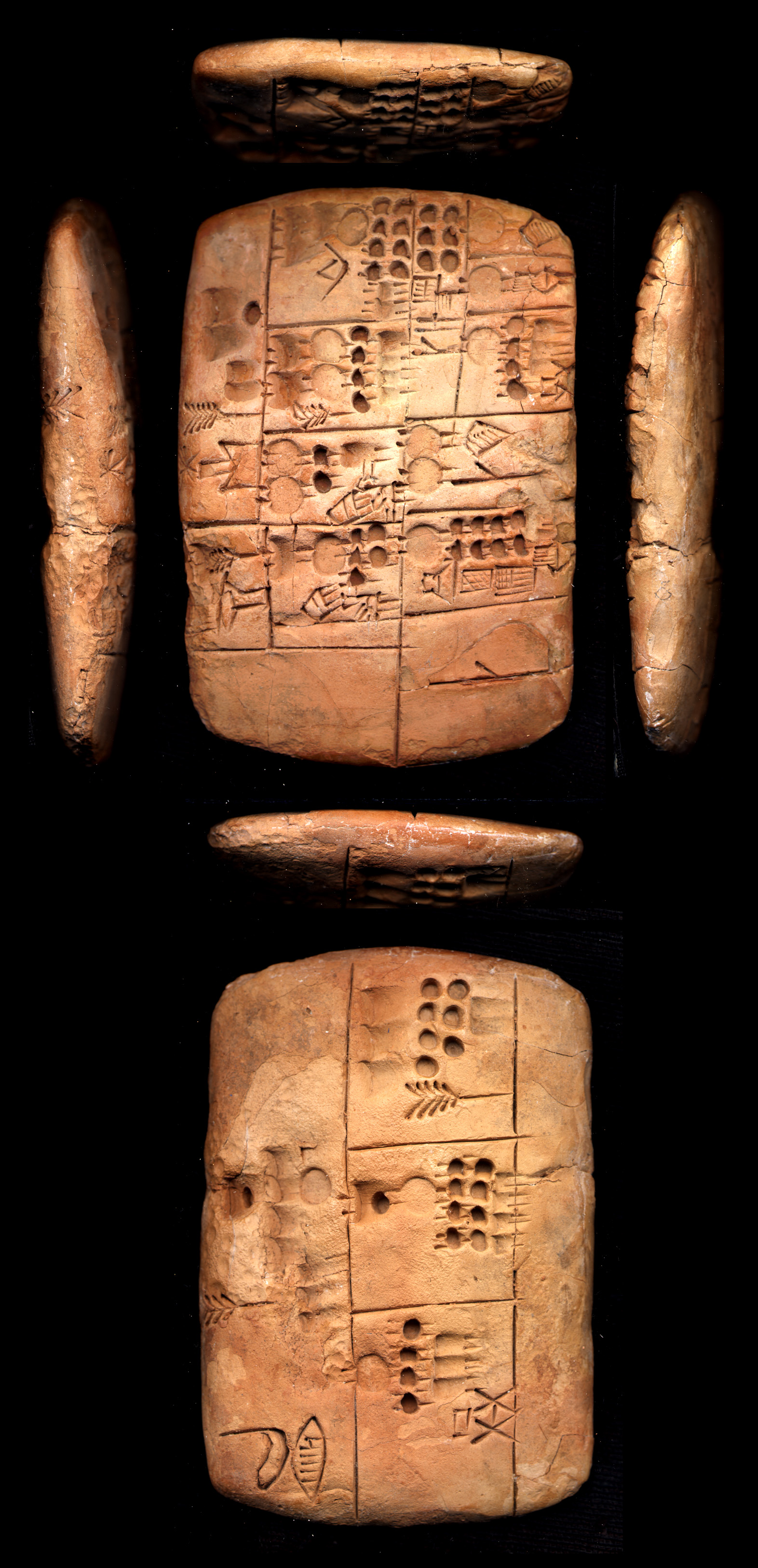
Proto-cuneiform tablet


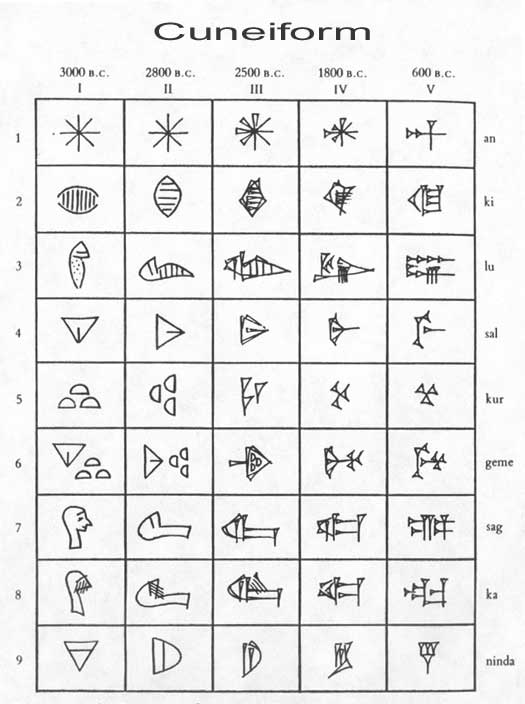
Changes in cuneiform script over time


In short, it���s not Sumerian. It���s either a modern fake or possibly an ancient local oddity (or something in between that has been modified with cuneiformish). So why does the ���Fuente Magna��� bowl (it is unclear how it got the name) continue to resonate? There are several reasons.

For one thing, there is the question of contacts between the New World and the Old World. This is a vast topic. Humans evolved in the Old World (Africa, actually), left that continent for Asia, and eventually schlepped to the New World. The timing and circumstances of that movement continues to be debated but the evidence points to it occurring by 12,000 BCE.

Contacts after that, however, are hugely controversial, and various claims have been made for Africans, Egyptians, Phoenicians, Israelites, Romans, Arabs, Japanese, Chinese, Polynesians, and others visiting or settling in the Americas, all prior to the Norse reaching Newfoundland around the year 1000 CE.

The evidence brought to support such theories is often difficult to judge (such as purported similarities in myths), have alternate explanations (such as independent technological or stylistic developments), or are pretty clear fakes (such as the Phoenician ���inscriptions��� in and ). The best we can say is that such contacts are not impossible but remain thus far unproven.

But how do we distinguish legitimate curiosity from unsavory agendas? Part of the answer here is to simply ask who is raising the questions and why. In the case of the Fuente Magna bowl, the first person to see it having a cuneiform inscription was apparently a Bolivian journalist, Mario Monta簽o Arag籀n, whose book Raices sem穩ticas en la religiosidad aymara y kichua (Semitic roots in Aymara and Quechua religion) was published in 1979.

Not having seen the book it is hard to say whether this somewhat bizarre inquiry was in keeping with centuries of research that has sought ���Semites,��� (including Israelites and ���lost��� tribes���) as well as other ancient Near Eastern groups, settling around the world, from Britain to the Americas.

The desire to connect local cultures with the presumably ���superior��� (or at least chronologically anterior) cultures of the Old World has many motives. For ��� of the 19th century and a few (who see their civilization founded by Egyptians), the exercise is connecting with myths of ancient nobility. Such interpretations may fly in the face of history as we know it (and indignant experts) but are really more articles of religious faith than anything else.

But all too often fringe interpretations have racist motives (the idea that local cultures 釵棗喝梭餃紳���t have developed without contact or guidance from ���superior��� civilizations), or at least racialist ones. For example, the individual who as (proto) Sumerian, , is a well-known Afrocentrist who believes that the Olmecs descended from Africans.

Here, unfortunately, we step further away from scientific method and consensus and towards the fringes. stitch together several theories and use data ranging from Greek mythology to genetics; that the Olmecs were black Africans (or Egyptians), that Atlantis was actually in Libya, that ���neo-Atlanteans��� founded settlements in Mexico, and much more. Each of these assertions is problematic if not extraordinary, with different types of evidence strung together breathlessly, to create a story that is extremely satisfying to the target audience.

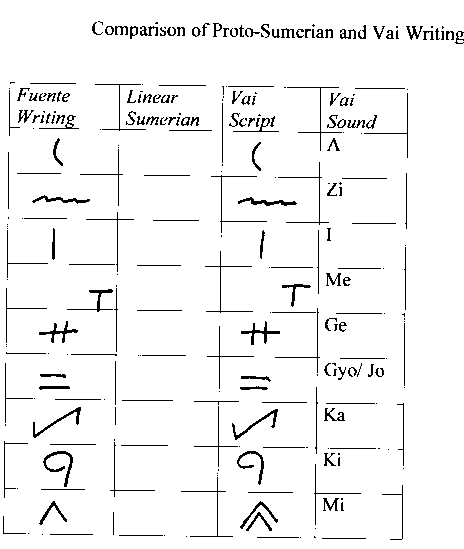
Winters��� ���translation��� of the Fuente Magna ���inscription��� is similarly extraordinary, relying on comparisons with a purported Saharan script that was also allegedly in common use in Mesopotamia, the Indus Valley, and West Africa, and which is understood using the Vai script of Liberia, which was created only 1830. This method is completely unfamiliar to conventional scholarship, because it is not scholarly as such but rather a kind of Gnosticism, the recovery of esoteric knowledge with the power of redemption.

Winters��� associations between Sumerian and Vai


And that is part of the appeal of fringe challenges to academic paradigms and scholarly elites. The novelty of method matches the novelty of conclusions, all which sticks it to the mainstream that is either too dumb to recognize the truth or which suppresses it. The truth is out there, as Fox Mulder of the X-Files used to say. This applies to Bigfoot, the alien technologies that built the Pyramids, or the Nazi bases on the Moon. Secret truths are power in the minds of the enlightened few.

Now of course, new discoveries are being made all the time, and previously dismissed theories sometimes come to be recognized as correct. The idea of continental drift was proposed during the 1920s and was ridiculed until proven correct during the 1960s. And Pluto was happily ensconced as the ninth planet until recently when scientists cruelly downgraded it to a ���dwarf planet.���

In archaeology new data have prompted continual revisions of how early the Americas were peopled. Confidently set at 9500 BCE during the 1960s, the date has marched further back time to the point where some respectable scholars suggest it may even have been 25 or 30 thousand years ago.

There are also gradual shift in paradigms, the result of evidence being patiently cataloged and pointed out by mainstream scholars, sometimes in the face of ridicule. Forty years ago scholars who pointed to the similarity of Greek and Near Eastern mythologies were on the margins, if not the fringe; now the question is how and why borrowings took place.

Non-specialists need to prod scholars who are too often married to (or hostage to, as some marriages are) their ideas. And scholars need to approach data honestly, without ideology or idealizing preconceived conclusions, and to continually reassess and rethink.

Thus far there is no meaningful evidence for Sumerian connections with the New World, and the Fuente Magna bowl, by virtue of being an unconvincing fake that teeters on an edifice of unfounded assumptions, doesn���t help the case. But looking carefully at how and why this case fails to persuade is a useful exercise, precisely for those reasons.

Alex Joffe is the editor of The Ancient Near East Today. He has a longstanding agreement to believe in the Loch Ness Monster if the Loch Ness Monster believes in him.

[/vc_column_text][/vc_column_inner][/vc_row_inner][/vc_column][/vc_row]

ANE TODAY – 201702 – Lights on the ���Dark Age���

[vc_row fullwidth=”true” css=”.vc_custom_1486761987223{padding-top: 0px !important;padding-right: 0px !important;padding-bottom: 0px !important;padding-left: 0px !important;}”][vc_column][vc_single_image image=”33901″ img_size=”full”][/vc_column][/vc_row][vc_row fullwidth=”true” css=”.vc_custom_1487275830783{padding-top: 10px !important;padding-right: 0px !important;padding-bottom: 0px !important;padding-left: 0px !important;}”][vc_column width=”1/12″ css=”.vc_custom_1493002455400{margin-right: 10px !important;}” offset=”vc_hidden-md vc_hidden-sm vc_hidden-xs”][vc_column_text]

泭釦晨插賊楚

[/vc_column_text][mk_image src=”http://www.asortest.org/wp-content/uploads/2017/01/social-fb-icon4.jpg” image_width=”42″ image_height=”42″ hover=”false” custom_url=”https://www.facebook.com/ASOResearch/” margin_bottom=”0″][mk_image src=”http://www.asortest.org/wp-content/uploads/2017/01/social-tw-icon4.jpg” image_width=”42″ image_height=”42″ hover=”false” custom_url=”https://twitter.com/ASOResearch?ref_src=twsrc%5Egoogle%7Ctwcamp%5Eserp%7Ctwgr%5Eauthor” margin_bottom=”0″][mk_image src=”http://www.asortest.org/wp-content/uploads/2017/01/social-in-icon4.jpg” image_width=”42″ image_height=”42″ hover=”false” custom_url=”https://www.linkedin.com/company/american-schools-of-oriental-research” margin_bottom=”0″][mk_image src=”http://www.asortest.org/wp-content/uploads/2017/01/social-ml-icon_7.jpg” image_width=”42″ image_height=”42″ hover=”false” custom_url=”mailto:asor@bu.edu” margin_bottom=”0″][mk_image src=”http://www.asortest.org/wp-content/uploads/2017/01/blog-icon3.jpg” image_width=”42″ image_height=”42″ hover=”false” custom_url=”http://asorblog.org/” margin_bottom=”0″][/vc_column][vc_column border_color=”rgba(255,255,255,0.01)” width=”1/6″ css=”.vc_custom_1493004112151{margin-right: 20px !important;border-left-width: 2px !important;padding-right: 20px !important;padding-left: 20px !important;border-left-color: #99422f !important;}”][mk_divider divider_color=”rgba(255,255,255,0.01)” thickness=”1″ margin_top=”3″ margin_bottom=”3″][vc_widget_sidebar sidebar_id=”sidebar-16″ el_class=”.widget { overflow: hidden; margin-bottom: 0; }”][/vc_column][vc_column border_color=”rgba(170,170,170,0.01)” width=”8/12″ css=”.vc_custom_1487276122024{margin-right: 10px !important;margin-bottom: 30px !important;border-right-width: 2px !important;border-bottom-width: 2px !important;padding-top: 30px !important;padding-right: 30px !important;padding-left: 20px !important;background-color: #ffffff !important;border-right-color: rgba(227,228,228,0.75) !important;border-bottom-color: rgba(227,228,228,0.75) !important;}”][vc_row_inner][vc_column_inner width=”1/3″ css=”.vc_custom_1515089133751{padding-right: 20px !important;}”][mk_image src=”http://www.asor.org/wp-content/uploads/2017/12/foa-reduced-100.png” image_width=”190″ image_height=”100″ crop=”false” hover=”false”][/vc_column_inner][vc_column_inner width=”2/3″][vc_column_text responsive_align=”left”]

February 2017

Vol. V, No. 2
[/vc_column_text][/vc_column_inner][/vc_row_inner][mk_divider thickness=”1″ margin_top=”10″][vc_row_inner][vc_column_inner][vc_column_text]

Lights on the ���Dark Age��� – Rethinking the Southern Levantine Early Bronze IV after a Century of Archaeological Investigation

詁聆泭Marta D���Andrea

Societal collapse has always been intriguing. For this reason scholars have been attracted to the Early Bronze IV of the Southern Levant (EB IV, ca. 2500-1950/1920 BCE) since the early 20th century. ��The EB IV is sandwiched between the collapse of the first cities at the end of EB III (ca. 2500 BCE) and the regeneration of urban society in the succeeding Middle Bronze Age (MBA, 1920-1550 BCE), when new cultural elements ��� generally connected with the Amorites ��� took the leading role in the entire Levant. This position saw EB IV as a ���Dark Age��� of social, political and economic collapse and technological regression. Lately, renewed interest in the EB IV has been fuelled by new discoveries, which allow for substantial re-evaluation of this still elusive period.

Archaeological evidence available for EB IV between the 1950s and the 1980s suggested that radical changes took place in the southern Levant after the collapse of the first cities. The presence of small unfortified villages in place of the fortified sites of the EB II-III periods, the fact that cemeteries outnumbered settlements, and the fragmentation of material culture, with several coexisting repertoires of pots and weapons distributed over limited areas, led scholars to conclude that mobility and nomadism rather than sedentism characterized the period. The diffusion of cultural influence from still urbanized Syria, inferable from the spread of cups and goblets inspired by northern prototypes across the southern Levant, was also taken as proof that people were moving, whether refugees, invaders, or pastoralists.

Map of the Southern Levant during the EB IV. Courtesy Marta D���Andrea.


Southern Levantine cups and goblets (graphic re-elaboration by the author from several sources; M. D���Andrea, The Southern Levant in Early Bronze IV. Issues and perspectives in the pottery evidence. CMAO XVII, Roma 2014, pls XVII:2, 9, XVIII:9-10, 12-13, XIX:7-8, XXI:10-11, 16, XXVIII:1-2, 7-8).


The EB IV was portrayed as a non-urban interlude after the failure of the first urban experiment, which, suddenly at the dawn of the 2nd millennium BCE, made way for the revival of urbanism, likely diffusing from more sophisticated Syria.

But intense field research from the 1980s to the present has revealed a myriad of sedentary EB IV rural villages both east and west of the Jordan River. Rather than a ���Dark Age��� of decline and recession, the southern Levantine EB IV was a complex phase in which rural components were fundamental. Early research separated phases based on stylistic differences between the ceramic assemblages of different sub-regions. Subsequently, several sites ��� including Tell Umm Hammad, Tell Abu en-Ni���aj, Khirbat Iskandar, Bab edh-Dhra���, Jericho, and, recently, Tell el-Hammam ��� revealed multiple EB IV strata and evidence for an evolutionary sequence.

EB IV superimposed architecture over EB III mudbrick destruction (courtesy of the Khirbat Iskandar Expedition), end of 2016 season.


EB IV superimposed architecture over EB III mudbrick destruction (courtesy of the Khirbat Iskandar Expedition), end of 2016 season.


Pottery from the first EB IV phase (Phase 1) identified in Area C at Khirbat Iskandar, Jordan, corresponding to early EB IV in the author���s periodization (courtesy of the Khirbat Iskandar Expedition).


Based on this new evidence, scholars have made arguments for the existence of elites and for the social development and technological experimentation, as well as for continuity with the following MBA. Finally, recent studies on ancient landscape, vegetation and climate demonstrated that there were cyclical episodes of aridification between 2500 and 1900 BCE that might have influenced settlement patterns and developments in the southern Levant during EB IV.

My argument builds on new research that reconstructs a progression, from crisis to recovery and growth. Building on the hypothesis that changes in pottery manufacturing techniques observable from one EB IV sub-phase to the next might be used for inter-site correlation, I attempted to piece together the archaeological evidence from different sites and areas, re-examining the published record from almost 150 sites. The study was boosted by first-hand analysis of EB IV pottery in museums and universities and the opportunity to expose more of the long EB IV sequence at Khirbat Iskandar, working with Suzanne Richard, from Gannon University, and Jesse Long, from Lubbock Christian University.

EB IV pottery in situ in Area B at Khirbat Iskandar, Jordan, corresponding to the central EB IV phase at the site (courtesy of the Khirbat Iskandar Expedition), 2013 season.


EB IV pottery from Area B at Khirbat Iskandar, Jordan, corresponding to the central EB IV phase at the site (courtesy of the Khirbat Iskandar Expedition), 2013 season.


EB IV multifunctional complex (���gateway���) in Area C at Khirbat Iskandar, Jordan (courtesy of the Khirbat Iskandar Expedition).


Based on my re-evaluation, I proposed that there was an early EB IV stage of crisis after the downfall of the EB II-III urbanization, a factor likely accounting for its low visibility in the archaeological record. The ephemeral nature of this early EB IV phase might reflect discontinuities, such as the establishment of short-lived settlements shifting from one place to another. The material culture of this archaic EB IV phase seems rather poor, pointing to technological regression and domestic manufacture, possibly mirroring changes in the socio-economic preconditions behind production.

In my interpretation, from a central EB IV stage, a process of continuous recovery and reorganization led to a final phase of growth, which gradually blended down into a transitional Early-Middle Bronze phase towards the end of EB IV. The beginning of renewed development from the central EB IV phase is suggested by the establishment of a network of well-planned sedentary rural villages, interacting with mobile components specializing in several activities in different areas, such as pastoralism, trade, and crafts. Specialized craft production, with the systematic use of the slow potters wheel, and copper mining, smelting, and trade, were resumed. The circulation of these products suggests that interactions between different regions and agricultural-pastoral communities were at work. Elements of ���complexity��� also began to appear throughout the southern Levant, indicated by the presence of multifunctional ���public��� areas, and ���warrior��� burials with metal weapons and ornaments. New styles in material culture point to local interpretation of foreign elements.

Drawing of EB IV Tomb L2 at Jericho, with deployment of metal weapons and ornaments within the burial (redrawn by the author after K.M. Kenyon, Excavations at Jericho II, London 1965, fig. 79).


The big picture emerging from the archaeological data for the central and late EB IV phases of sedentary rural communities dynamically interacting with semi-nomads in an organized manner, based on specialization of economic activities. It was during these phases that regional and inter-regional connections were gradually re-established, which fuelled the diffusion of technology, styles and cultural information from the neighboring areas. Although the central and late EB IV stages were non-urban, it seems likely that the first seeds of the MBA urban regeneration were sown during these phases.

Thus, research over the last three decades has deeply changed our understanding of the southern Levantine EB IV, bringing into sharper focus the existence of the internal developments, from crisis to recovery and growth. So far this is mostly understood in terms of relative phases within a six-century-long period. The refinement of an absolute chronology for EB IV phases is a priority, linking stratigraphy at individual sites, ceramic phases, and absolute dates from scientific methods.

Many questions remain. Did the Early Bronze Age urban crisis occur at the same time and pace at every site and region? When did recovery first start and did it occur simultaneously throughout the region? How do these patterns connect with climatic oscillations between 2500-1900 BCE? And how does the southern Levant during EB IV connect with neighboring areas, such as Egypt, the Lebanon, and Syria, for which absolute chronologies are more refined? These and many more compelling questions might be answered by chronological revisions. Unveiling synchronisms will eventually shed light on the social, political and economic intricacies of the southern Levantine EB IV that we are not able to grasp due to the lack of written sources.

Marta D���Andrea is a research fellow at Sapienza University of Rome, Italy, and a co-director of the Archaeological Expedition to Khirbat Iskandar and Its Environs, Jordan and the Madaba Regional Archaeological Museum Project, Jordan.

[/vc_column_text][/vc_column_inner][/vc_row_inner][/vc_column][/vc_row]

Table of Contents for NEA 80.4 (December 2017)

[vc_row fullwidth=”true” attached=”true” css=”.vc_custom_1496247803139{padding-top: 0px !important;padding-right: 0px !important;padding-bottom: 0px !important;padding-left: 0px !important;}”][vc_column][mk_image src=”http://www.asor.org/wp-content/uploads/2018/01/NEA80_4toc-banner.png” image_width=”1920″ image_height=”400″ hover=”false” margin_bottom=”0″][/vc_column][/vc_row][vc_row fullwidth=”true” css=”.vc_custom_1496682730308{padding-top: 10px !important;padding-right: 0px !important;padding-bottom: 0px !important;padding-left: 0px !important;}”][vc_column width=”1/12″ css=”.vc_custom_1496683820796{margin-right: 10px !important;}” offset=”vc_hidden-md vc_hidden-sm vc_hidden-xs”][vc_column_text]

泭釦晨插賊楚

[/vc_column_text][mk_image src=”http://www.asortest.org/wp-content/uploads/2017/01/social-fb-icon4.jpg” image_width=”42″ image_height=”42″ hover=”false” custom_url=”https://www.facebook.com/ASOResearch/” margin_bottom=”0″][mk_image src=”http://www.asortest.org/wp-content/uploads/2017/01/social-tw-icon4.jpg” image_width=”42″ image_height=”42″ hover=”false” custom_url=”https://twitter.com/ASOResearch?ref_src=twsrc%5Egoogle%7Ctwcamp%5Eserp%7Ctwgr%5Eauthor” margin_bottom=”0″][mk_image src=”http://www.asortest.org/wp-content/uploads/2017/01/social-in-icon4.jpg” image_width=”42″ image_height=”42″ hover=”false” custom_url=”https://www.linkedin.com/company/american-schools-of-oriental-research” margin_bottom=”0″][mk_image src=”http://www.asortest.org/wp-content/uploads/2017/01/social-ml-icon_7.jpg” image_width=”42″ image_height=”42″ hover=”false” custom_url=”mailto:asor@bu.edu” margin_bottom=”0″][mk_image src=”http://www.asortest.org/wp-content/uploads/2017/01/blog-icon3.jpg” image_width=”42″ image_height=”42″ hover=”false” custom_url=”http://asorblog.org/” margin_bottom=”0″][/vc_column][vc_column border_color=”rgba(255,255,255,0.01)” width=”1/6″ css=”.vc_custom_1496683923840{margin-right: 20px !important;border-left-width: 2px !important;padding-right: 20px !important;padding-left: 20px !important;border-left-color: #99422f !important;}”][mk_divider divider_color=”rgba(255,255,255,0.01)” thickness=”1″ margin_top=”3″ margin_bottom=”3″][vc_column_text]

[/vc_column_text][/vc_column][vc_column border_color=”rgba(170,170,170,0.01)” width=”1/2″ css=”.vc_custom_1487276122024{margin-right: 10px !important;margin-bottom: 30px !important;border-right-width: 2px !important;border-bottom-width: 2px !important;padding-top: 30px !important;padding-right: 30px !important;padding-left: 20px !important;background-color: #ffffff !important;border-right-color: rgba(227,228,228,0.75) !important;border-bottom-color: rgba(227,228,228,0.75) !important;}”][vc_column_text responsive_align=”left”]

Table of Contents for Near Eastern Archaeology 80.4 (December 2017)

Subscription Options
You can receive (and other ) through an or through an . Single issues (subject to availability) are available for purchase, with 17勛圖members receiving a discount. Please email us if you have any questions.

Pp. 212-231: “The Tell e廜�-廜〡▅i/Gath Archaeological Project: Overview,” by Aren M. Maeir

The Tell e廜�-廜〡▅i/Gath Archaeological Project commenced in 1996 and is one of the largest and longest continuously running archaeological projects in Israel. As the year 2017 marks twenty-two years of research and excavations, it is an apt opportunity to present an overview and reflection on the project in general, and various aspects of the research in particular. The opportunity to do this in two special issues of NEA is an excellent occasion, as this provides an expertly produced medium, read by many interested in the field of ancient Near Eastern history, archaeology, and culture.1 In this, first article of this special issue, I would like to provide an overview of the project and its primary accomplishments.

to access the above article on JSTOR (17勛圖membership with online access and/or subscription to JSTOR Current Content required).

Pp. 232-240: “Gath of the Philistines in the Bible and on the Ground: The Historical Geography of Tell e廜�-廜〡▅i/Gath,” by Yigal Levin

Archaeology is, for the most part, the study of material remains of the past. Archaeologists survey, excavate, analyze and construct a picture of past human life. They do their best to understand the daily life, the economy, the belief systems, the political and social structures, and so much else about long-gone civilizations. And, in many parts of the world and for long stretches of the human past, they do without recourse to written sources, simply because writing did not exist through most of that time. But if and when written records are available, they provide context, specific facts and dates, and much additional information that then give us a more complete picture of the history of the site or area that we are investigating.

to access the above article on JSTOR (17勛圖membership with online access and/or subscription to JSTOR Current Content required).

Pp. 241-243: “New Insights into Bliss and Macalister’s Excavations at Tell e廜�-廜〡▅i/Gath,” by Rona S. Avissar Lewis and Aren M. Maeir

By 1899, Frederick J. Bliss was already a well-known archaeologist when he was asked by the Palestine Exploration Fund (PEF) to excavate the Shephelah mounds. Previously, he dug with William Flinders Petrie at Maidon and then replaced Petrie at Tell el-Hesi (1891���1893). Subsequently, Bliss excavated with Archibald Dickie in Jerusalem on behalf of the PEF (1894���1897). R. A. Stewart Macalister served as Bliss’s assistant field director. He had some experience in archaeological excavations in England, considered himself a photographer, and was ���engaged with the architectural profession��� as he claimed (Bliss 1894: 2; Albright 1956: 24; Moorey 1991: 26���27; Tubb 2015: 6���7). The site of Tell e廜�-廜〡▅i/Gath had been known to scholars for many years prior to the three seasons of excavations conducted by Bliss and Macalister from 1899 as part of the Shephelah mounds (Smith 1894: 142���43; Rey 1871: 123���25; Conder 1879: 153; Petrie 1891: 62; Waston 1915: 117).

to access the above article on JSTOR (17勛圖membership with online access and/or subscription to JSTOR Current Content required).

Pp. 244-246: “Ancient Environment and Human Interaction at Tell e廜�-廜〡▅i/Gath,” by Oren Ackermann, Noam Greenbaum, Hendrik Bruins, Avner Ayalon, Miryam Bar-Matthews, Dan Cabanes, Liora Kolska Horwitz, Frank H. Neumann, Mechael Osband, Naomi Porat, Ehud Weiss and Aren M. Maeir

An archaeological site is an integral part of its surrounding landscape. This is one of the main novel approaches in the long-term archaeological project of Tell e廜�-廜〡▅i/Gath. The site has interacted with its surrounding for more than three thousand years. It was impacted by the ancient environment, but also had an impact on both the ancient environment and current conditions. The following is a summary of environmental research that has been carried out at the Tell e廜�-廜〡▅i/Gath environs from 1999 through 2012. This case study provides important information regarding the ancient landscape and interactions between climate, the environment, and humans.

to access the above article on JSTOR (17勛圖membership with online access and/or subscription to JSTOR Current Content required).

Pp. 247-254: “The Early Bronze Age at Tell e廜�-廜〡▅i/Gath,” by Haskel J. Greenfield, Itzhaq Shai and Aren M. Maeir

In 1899, Bliss and Macalister launched a brief but intensive campaign of excavation at the site of Tell e廜�-廜〡▅i/Gath and uncovered evidence for a large-scale fortification system and thick deposits from various time periods. While they argued that the majority of remains, including the fortifications, were of Iron Age or later origin, some Early Bronze Age remains also appeared in their reports and collections.

to access the above article on JSTOR (17勛圖membership with online access and/or subscription to JSTOR Current Content required).

Pp. 255-258: “Animal Food Production and Consumption in Stratum E5 at Early Bronze Age Tell e廜�-廜〡▅i/Gath,” by Haskel J. Greenfield, Tina L. Greenfield and Annie Brown

to access the above article on JSTOR (17勛圖membership with online access and/or subscription to JSTOR Current Content required).

Pp. 259-260: “Microdebris Analysis from the Early Bronze Age Levels at Tell e廜�-廜〡▅i/Gath,” by Annie Brown and Haskel J. Greenfield

Microdebris are the tiny remnants of activities that are not cleaned up after an activity is completed (fig. 1). Such activities are often archaeologically invisible with standard macrolevel artifact collection and analysis techniques. If microdebris are systematically and spatially collected across surfaces and different depositional contexts, their analysis can help guide excavation strategies (identification where such debris is located, which deposits are worth floating), identify activity areas, pest distributions, when, and which, rooms were used or abandoned, missing food sources that cannot be recovered through hand collections (plants, fish, and smaller remains), and so on (Rainville 2012; Steadman 1996; Rosen 1989; Weiner 2010). The utility of this approach is demonstrated with data from the Early Bronze Age excavations in Area E at Tell e廜�-廜〡▅i/Gath.

to access the above article on JSTOR (17勛圖membership with online access and/or subscription to JSTOR Current Content required).

Pp. 261-263:��“Isotope Analyses of Early Bronze Age Fauna at Tell e廜�-廜〡▅i/Gath,” by Elizabeth R. Arnold and Haskel J. Greenfield

��to access the above article on JSTOR (17勛圖membership with online access and/or subscription to JSTOR Current Content required).

Pp. 264-267:��“Interregional Trade and Exchange at Early Bronze Age Tell e廜�-廜〡▅i/Gath,” by Elizabeth Arnold, Jeremy Beller, Adi Behar, David Ben-Shlomo, Tina L. Greenfield and Haskel J. Greenfield

��to access the above article on JSTOR (17勛圖membership with online access and/or subscription to JSTOR Current Content required).

Pp. 268-269:��“Spatial Reconstruction of Selected Finds from the Early Bronze Age Neighborhood at Tell e廜�-廜〡▅i/Gath, Area E,” by Tina L. Greenfield and Andrea Squitieri

��to access the above article on JSTOR (17勛圖membership with online access and/or subscription to JSTOR Current Content required).

Pp. 270-272:��“Evidence for Administration and Leisure/Recreation at Early Bronze Age Tell e廜�-廜〡▅i/Gath,” by Shira Albaz, Haskel J. Greenfield, Tina L. Greenfield and Aren M. Maeir

��to access the above article on JSTOR (17勛圖membership with online access and/or subscription to JSTOR Current Content required).

Pp. 273-275:��“Ceramic Vessel Production and Use at Early Bronze Age Tell e廜�-廜〡▅i/Gath,” by Jon Ross and David Ben-Shlomo

��to access the above article on JSTOR (17勛圖membership with online access and/or subscription to JSTOR Current Content required).

Pp. 276-278:��“Archaeological Science in the Early Bronze Age Levels,” by Adi Eliyahu-Behar

��to access the above article on JSTOR (17勛圖membership with online access and/or subscription to JSTOR Current Content required).

Pp. 279-281: “Early Bronze Age Basalt Vessel Remains from Tell e廜�-廜〡▅i/Gath,” by Jeremy A. Beller

Basalt is long thought to have been one of the more valued geological materials from which ground stone objects were manufactured (Ebeling and Rowan 2004: 108; Milevski 2008). Although it was readily available in some regions of the southern Levant, the widespread utilization of basaltic material was likely due to its physical and aesthetic properties. As a quick-cooling, extrusive igneous rock, basalt is dominated by mafic minerals and characterized by a high durability and hardness (Mohs’ scale 7), a fine-grained texture, and a green-black colored appearance (Le Maitre 2002). Furthermore, basalt sheens well and leaves less grit in processed food than other materials (Ebeling and Rowan 2004: 108).

��to access the above article on JSTOR (17勛圖membership with online access and/or subscription to JSTOR Current Content required).

Pp. 282-284:��“Building a City Wall: An Administrative Perspective,” by Jill C. Katz

During the Early Bronze Age II/III, Tell e廜�-廜〡▅i/Gath was fortified by a city wall. This wall has been exposed now in several areas, stretching from the acropolis in the west (Area F), alongside the central part of the southern ridge (Area P; fig. 1) to the lower slopes in the east (Area J), just below a significant Early Bronze Age neighborhood in Area E. In general, the wall width is approximately 2.5 m, but varies along its length, including periodic offsets that protrude over 0.5 m. The longest stretch of contiguous wall currently visible is 21 m, and a portion of that was exposed all the way to its foundation. This probe revealed that the stone structure itself was comprised of large and medium-sized, roughly-cut, local fieldstones to a height of 10 courses, or 2.4 m (fig. 2). In addition, there was most likely an original mud-brick superstructure on top of the stones as implied by the thick decomposed mud-brick accumulation just outside the wall.

��to access the above article on JSTOR (17勛圖membership with online access and/or subscription to JSTOR Current Content required).

Pp. 285-291:��“Walled Up To Heaven! Early and Middle Bronze Age Fortifications at Tell e廜�-廜〡▅i/Gath,” by Jeffrey R. Chadwick, Joe Uziel, Eric L. Welch and Aren M. Maeir

The Early Bronze Age city at Tell e廜�-廜〡▅i/Gath was among the largest urban centers in Canaan, or whatever they called their land at that time (Maeir 2012b: 13; Shai et al. 2016). The city and its people are still mostly a mystery to us. We do not know what they called themselves, or their city (but it was almost surely not ���Gath���). They did not write, and we are not sure what language they spoke���perhaps an early Canaanite dialect. We do not know the names of any of their kings, as we do in most other periods at the site. But our excavations have taught us some things about them, their architecture, their pottery, and their diet. And we also know a good deal about the massive and extensive fortification wall that they built around their city, and that it must have taken a remarkable amount of organization and resources to accomplish it.

��to access the above article on JSTOR (17勛圖membership with online access and/or subscription to JSTOR Current Content required).

Pp. 292-295:��“The Late Bronze Age at Tell e廜�-廜〡▅i/Gath,” by Itzhaq Shai, Joe Uziel, Jeffrey R. Chadwick and Aren M. Maeir

The story of Canaanite Gath begins with the el-Amarna texts (Na’aman 1979; Rainey 2012; Levin, this issue), where it appears that the city was a major contender in the Shephelah power plays of the fourteenth century B.C.E. While some have contended the connection between Gath, Tell e廜�-廜〡▅i and the Amarna period ruler ��uwardatu (Moran 1992: 384), the petrographic examination conducted on the tablets create a strong link between them (Goren, Finkelstein, and Na’aman 2004: 280���86). In this light, the results of the surface survey prior to the onset of the excavations noted the existence of a large settlement at Tell e廜�-廜〡▅i/Gath (ca. 27 ha; see:Uziel and Maeir 2005: 56). Yet, the survey results did not allow identification of differences within the Late Bronze Age (LB) between the subphases of the period.

��to access the above article on JSTOR (17勛圖membership with online access and/or subscription to JSTOR Current Content required).

Pp. 296-297:��“Late Helladic Imported Pottery at Tell e廜�-廜〡▅i/Gath,” by Philipp W. Stockhammer

Fragments of thirty-six Aegean-type vessels were found at Tell e廜�-廜〡▅i/Gath in Areas A, E, F, and P between 1996 and 2014, some of which have already been published (Gadot, Yasur-Landau, and Uziel 2012; Shai et al., this issue) and then subsequently revaluated in a broader context (Stockhammer in press). The earliest import so far can be dated to the Mycenaean pottery phase Late Helladic (LH) IIIA1, which is the late fifteenth and early fourteenth centuries B.C.E. This closed vessel of unclear shape can be considered as one of the early Mycenaean imports to the southern Levant. It reached this region in a time when the spectrum of imports was still dominated by Aegean-type pottery from Crete.

��to access the above article on JSTOR (17勛圖membership with online access and/or subscription to JSTOR Current Content required).

Pp. 298-299:��“Fragments of Egyptian Writing from Tell e廜�-廜〡▅i/Gath,” by Stefan Jakob Wimmer

Some Egyptian inscriptions from Tell e廜�-廜〡▅i/Gath are found on amulets, such as a miniature figurine of the goddess Isis suckling the baby Horus and identified on the back pillar with a few hieroglyphs as 3s.t wr.t nb.t ���Isis the Great, the Mistress��� (Wimmer and G繹rg in press), and of course on scarabs (e.g., M羹nger, NEA forthcoming), such as abound on practically all sites in the Levant. Apart from these, traces of Egyptian writing are sparse at Tell e廜�-廜〡▅i/Gath.

��to access the above article on JSTOR (17勛圖membership with online access and/or subscription to JSTOR Current Content required).

[/vc_column_text][mk_divider][vc_column_text]To view the entire issue on JSTOR, .[/vc_column_text][/vc_column][vc_column border_color=”rgba(170,170,170,0.01)” width=”1/6″ css=”.vc_custom_1496684098866{margin-right: 5px !important;margin-bottom: 20px !important;border-right-width: 2px !important;border-bottom-width: 2px !important;padding-top: 30px !important;padding-right: 10px !important;padding-left: 10px !important;background-color: #ffffff !important;border-right-color: rgba(227,228,228,0.75) !important;border-bottom-color: rgba(227,228,228,0.75) !important;}”][vc_wp_posts title=”BROWSE THE NEWS ARCHIVE” number=”4″][/vc_column][vc_column border_color=”rgba(170,170,170,0.01)” width=”1/6″ css=”.vc_custom_1496684008271{margin-right: 10px !important;margin-bottom: 30px !important;border-right-width: 2px !important;border-bottom-width: 2px !important;padding-top: 30px !important;padding-right: 20px !important;padding-left: 20px !important;background-color: #ffffff !important;border-right-color: rgba(227,228,228,0.75) !important;border-bottom-color: rgba(227,228,228,0.75) !important;}”][vc_column_text] [/vc_column_text][/vc_column][/vc_row]

ANE TODAY VOL V n03 (2017)

[vc_row fullwidth=”true” css=”.vc_custom_1486761987223{padding-top: 0px !important;padding-right: 0px !important;padding-bottom: 0px !important;padding-left: 0px !important;}”][vc_column][vc_single_image image=”33901″ img_size=”full”][/vc_column][/vc_row][vc_row fullwidth=”true” css=”.vc_custom_1487275830783{padding-top: 10px !important;padding-right: 0px !important;padding-bottom: 0px !important;padding-left: 0px !important;}”][vc_column width=”1/12″ css=”.vc_custom_1493002455400{margin-right: 10px !important;}” offset=”vc_hidden-md vc_hidden-sm vc_hidden-xs”][vc_column_text]

泭釦晨插賊楚

[/vc_column_text][mk_image src=”http://www.asortest.org/wp-content/uploads/2017/01/social-fb-icon4.jpg” image_width=”42″ image_height=”42″ hover=”false” custom_url=”https://www.facebook.com/ASOResearch/” margin_bottom=”0″][mk_image src=”http://www.asortest.org/wp-content/uploads/2017/01/social-tw-icon4.jpg” image_width=”42″ image_height=”42″ hover=”false” custom_url=”https://twitter.com/ASOResearch?ref_src=twsrc%5Egoogle%7Ctwcamp%5Eserp%7Ctwgr%5Eauthor” margin_bottom=”0″][mk_image src=”http://www.asortest.org/wp-content/uploads/2017/01/social-in-icon4.jpg” image_width=”42″ image_height=”42″ hover=”false” custom_url=”https://www.linkedin.com/company/american-schools-of-oriental-research” margin_bottom=”0″][mk_image src=”http://www.asortest.org/wp-content/uploads/2017/01/social-ml-icon_7.jpg” image_width=”42″ image_height=”42″ hover=”false” custom_url=”mailto:asor@bu.edu” margin_bottom=”0″][mk_image src=”http://www.asortest.org/wp-content/uploads/2017/01/blog-icon3.jpg” image_width=”42″ image_height=”42″ hover=”false” custom_url=”http://asorblog.org/” margin_bottom=”0″][/vc_column][vc_column border_color=”rgba(255,255,255,0.01)” width=”1/6″ css=”.vc_custom_1493004112151{margin-right: 20px !important;border-left-width: 2px !important;padding-right: 20px !important;padding-left: 20px !important;border-left-color: #99422f !important;}”][mk_divider divider_color=”rgba(255,255,255,0.01)” thickness=”1″ margin_top=”3″ margin_bottom=”3″][vc_widget_sidebar sidebar_id=”sidebar-16″ el_class=”.widget { overflow: hidden; margin-bottom: 0; }”][/vc_column][vc_column border_color=”rgba(170,170,170,0.01)” width=”8/12″ css=”.vc_custom_1487276122024{margin-right: 10px !important;margin-bottom: 30px !important;border-right-width: 2px !important;border-bottom-width: 2px !important;padding-top: 30px !important;padding-right: 30px !important;padding-left: 20px !important;background-color: #ffffff !important;border-right-color: rgba(227,228,228,0.75) !important;border-bottom-color: rgba(227,228,228,0.75) !important;}”][vc_row_inner][vc_column_inner width=”1/3″ css=”.vc_custom_1515087305797{padding-right: 20px !important;}”][mk_image src=”http://www.asor.org/wp-content/uploads/2017/12/foa-reduced-100.png” image_width=”190″ image_height=”100″ crop=”false” hover=”false”][/vc_column_inner][vc_column_inner width=”2/3″][vc_column_text responsive_align=”left”]

March 2017

Vol. 5, No. 3
[/vc_column_text][/vc_column_inner][/vc_row_inner][mk_divider thickness=”1″ margin_top=”0″][vc_row_inner][vc_column_inner][vc_column_text]

Lights on the ���Dark Age��� ��� Rethinking the Southern Levantine Early Bronze IV after a Century of Archaeological Investigation

By Marta D���Andrea

Societal collapse has always been intriguing. For this reason scholars have been attracted to the Early Bronze IV of the Southern Levant (EB IV, ca. 2500-1950/1920 BCE) since the early 20th century.

READ MORE
[/vc_column_text][mk_divider thickness=”1″ margin_top=”10″][/vc_column_inner][/vc_row_inner][vc_row_inner][vc_column_inner][vc_column_text]

���Joy plants��� and the Earliest Toasts in the Ancient Near East

By Elisa Guerra Doce

Inebriation is a cross-cultural habit whose origins can be traced back to Prehistory. But humans are not the only species fond of the mind-altering effects of certain plants and drinks. Some animals are also attracted to overripe fruits and psychoactive plants.

READ MORE
[/vc_column_text][mk_divider thickness=”1″ margin_top=”10″][/vc_column_inner][/vc_row_inner][vc_row_inner][vc_column_inner][vc_column_text]

Kamid el-Loz ��� A Short Story in 900 Words

By Marlies Heinz

Across 2000 years of history the residents of Kamid el-Loz, one of the major sites in Lebanon���s Beqa���a plain, lived through: (1) three phases of urbanization, de-urbanization, and re-urbanization; (2) two phases of collapse and the irreversible dissolution of urban life; (3) four episodes of imperialist rule.

READ MORE
[/vc_column_text][mk_divider thickness=”1″ margin_top=”10″][/vc_column_inner][/vc_row_inner][vc_row_inner][vc_column_inner][vc_column_text]

The Dead Sea Scrolls at Seventy

詁聆泭Timothy Lim

This year marks the seventieth anniversary of the discovery of the Dead Sea Scrolls. What have we learned over the past three score and ten? First, it has become increasingly recognized that we do not have a ���library of the Essenes��� in the way that it was previously understood.

READ MORE
[/vc_column_text][mk_divider thickness=”1″ margin_top=”10″][/vc_column_inner][/vc_row_inner][vc_row_inner][vc_column_inner][vc_column_text]

Do You Get to Keep What You Find?

By Eric Cline

There is one question that I am asked all the time, which has a short answer but is long on associated implications. The question is simply ���Do you get to keep what you find?��� The answer is very short: ���No.��� Whether you���re working in your own country or in a country other than your own, that nation���s antiquities department will have a set of rules.

READ MORE
[/vc_column_text][mk_divider thickness=”1″ margin_top=”10″][/vc_column_inner][/vc_row_inner][vc_row_inner][vc_column_inner][vc_column_text]The Ancient Near East Today features contributions from diverse academics, a forum featuring debates of current developments from the field, and links to news and resources. The ANE Today covers the entire Near East, and each issue presents discussions ranging from the state of biblical archaeology to archaeology after the Arab Spring.

Take a look at the contents of this e-book!

  • Lights on the ���Dark Age��� – Rethinking the Southern Levantine Early Bronze IV after a Century of Archaeological Investigation
  • ���Joy Plants��� and the Earliest Toasts in the Ancient Near East
  • Kamid el-Loz ��� A Short Story in 900 Words
  • The Dead Sea Scrolls at Seventy
  • Do You Get to Keep What You Find?
[/vc_column_text][mk_divider thickness=”1″ margin_top=”10″][/vc_column_inner][/vc_row_inner][/vc_column][/vc_row]